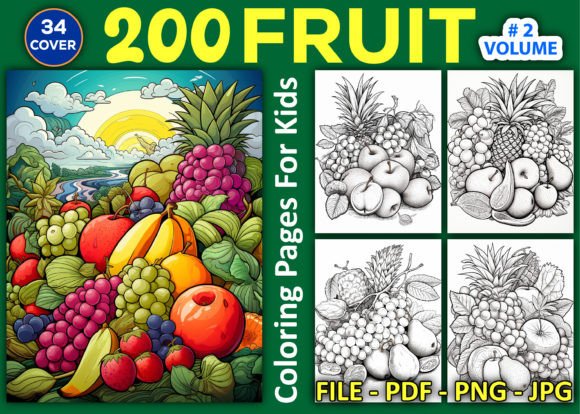
200 Fruit Coloring Pages for Kids V-2
For creators building print-on-demand coloring books on Amazon KDP—or designing activity kits, classroom resources, or branded educational products—200 Fruit Coloring Pages for Kids V-2 is more than a collection of illustrations. It’s a strategic asset: 200 high-resolution, A4- and letter-sized pages (8.5×11″), delivered in PDF, JPG, and PNG formats at 300 dpi, with 34 cover-ready PNG files included. This isn’t clipart repackaged—it’s a purpose-built interior toolkit designed to accelerate production while preserving creative control and professional output quality.
Why Resolution, Format, and Flexibility Matter More Than Quantity Alone
Many coloring page bundles promise volume—but few deliver true production readiness. 200 Fruit Coloring Pages for Kids V-2 stands out because every file meets industry-grade print standards: crisp linework, clean vector-derived outlines, and consistent spacing optimized for both home printers and commercial presses. The inclusion of PDF, JPG, and PNG ensures compatibility across workflows—whether you’re importing into Canva for layout, refining line weight in Affinity Designer, or prepping for KDP’s automated interior validation. That flexibility reduces friction in your pipeline: fewer last-minute conversions, fewer rejected uploads, fewer customer complaints about blurry edges or misaligned margins.
This matters most when scaling. If you manage multiple KDP titles—or plan to launch seasonal variations (e.g., “Summer Fruits,” “Tropical Favorites”)—having 200 distinct, non-repeating fruit designs means you can build thematic continuity without duplicating assets across books. No need to license new illustrations for each edition. No need to redraw apples, bananas, or dragonfruit from scratch. You invest once, deploy repeatedly, and retain full commercial rights.
Strategic Positioning Starts With Intentional Curation
Fruit-themed coloring pages are widely searched—but saturation doesn’t mean opportunity is gone. It means differentiation hinges on execution. 200 Fruit Coloring Pages for Kids V-2 supports intentional positioning in three concrete ways:
- Age-tier alignment: The line work balances simplicity for early learners (ages 3–6) with subtle detail for older children (7–10)—supporting broader market reach without splitting your SKU strategy.
- Educational scaffolding: These aren’t just shapes. Each fruit reflects botanical accuracy—distinct leaf arrangements, stem structures, skin textures—making them usable in science units, nutrition lessons, or ESL vocabulary builders.
- Brand coherence: Because all 200 pages share consistent stroke weight, spacing, and proportion, they reinforce visual trust. Readers recognize your book as part of a cohesive series—even if you never use the same cover twice.
That consistency builds recognition faster than random illustration sets ever could. For educators selling supplemental materials or small publishers developing themed activity lines, that reliability translates directly into repeat purchases and lower customer acquisition costs.
When—and When Not—to Use This Resource
Use 200 Fruit Coloring Pages for Kids V-2 when your goal is speed-to-market without sacrificing quality. It’s ideal for launching a first KDP coloring book within 72 hours of purchase—or adding a fruit-themed volume to an existing catalog without diverting design bandwidth. It also works well for bundling: pair it with a simple “Fruit Facts” companion page (you add the text), create flashcards using the PNGs, or embed individual images into digital lesson plans.
Avoid using it as a default fallback. If your brand voice leans toward whimsy, but these illustrations lean toward clean realism, forcing them into a “fun farm adventure” theme creates dissonance—not delight. Likewise, if your audience expects cultural specificity (e.g., regional fruits like rambutan or guava depicted with local context), generic renderings may feel disconnected unless supplemented intentionally.
The risk isn’t in the pages themselves—it’s in deploying them without aligning them to your goals. Throwing 200 fruit drawings into a PDF and uploading it won’t move the needle. But thoughtfully sequencing them—grouping by color families, arranging from common to exotic, adding subtle learning cues in margins—turns passive content into active engagement.
Design Decisions That Amplify Value
Your interior layout determines how much perceived value readers assign to your book—even before they flip past the title page. With 200 Fruit Coloring Pages for Kids V-2, you control that perception through deliberate choices:
- Page rhythm: Alternate single-fruit focus pages with double-page spreads showing fruit-in-context (e.g., banana on a tree, strawberry in a basket). This variation sustains attention across longer sessions.
- White space discipline: Don’t overcrowd. These illustrations breathe best with generous margins. KDP’s 8.5×11″ trim allows room for binding—use it. Cluttered interiors fatigue young eyes and signal low production value.
- Cover-to-interior continuity: Select 3–5 interior pages that echo key elements in your cover design—same fruit, similar line style, matching negative space treatment. That visual echo reinforces cohesion at first glance.
You don’t need advanced design skills to make these calls. You do need clarity about who’s holding the book and why. Is it for independent coloring? Classroom centers? Therapeutic use? Each answer shifts optimal layout choices. A therapist might prioritize large, open outlines; a teacher may want space for handwritten labels. Let your audience—not the file count—drive structure.
Long-Term Leverage Beyond the First Upload
Think of 200 Fruit Coloring Pages for Kids V-2 not as a one-time interior, but as a modular foundation. You can extract individual PNGs to build social media assets (“Color this kiwi! Tag us when done”), convert select pages into SVGs for Cricut users, or layer them into animated video explainers about healthy eating. Because all files are 300 dpi and print-ready, repurposing doesn’t degrade quality—unlike downscaled web graphics.
Over time, this set becomes part of your intellectual infrastructure: a reliable, reusable component in your creative stack. Just as developers rely on trusted libraries, or marketers reuse proven email templates, having 200 vetted, production-grade fruit illustrations means less time sourcing, more time refining messaging, positioning, or customer experience.
That efficiency compounds. One creator used 42 pages from this set to build a “Fruit Alphabet” book (A for Apple, B for Banana…), then reused the remaining 158 across four seasonal titles—each with custom covers, themed intros, and age-targeted activity prompts. Total development time: under 10 hours. Total KDP titles launched in Q1: five. That’s not luck. It’s leverage—applied deliberately.
Final Consideration: Ownership Enables Adaptation
You’re granted full commercial rights—including resale rights. That means you’re not leasing access. You’re acquiring capability. You can resize, recolor, annotate, combine with original art, or integrate into subscription kits. You’re not locked into a platform’s template constraints or forced to credit a third party.
But rights alone don’t guarantee results. What does is asking, before you open the ZIP file: What outcome am I trying to create—not just for this book, but for my next three? If the answer involves building authority in early childhood resources, then pair these pages with original teaching notes. If it’s about diversifying income streams, use them as lead magnets behind a free “Healthy Snack Guide.” If it’s brand-building, treat each fruit as a character—give them names, backstories, even tiny speech bubbles in later editions.
200 Fruit Coloring Pages for Kids V-2 gives you the raw material. Your strategy determines whether it becomes background noise—or a meaningful, measurable asset in your creative practice.