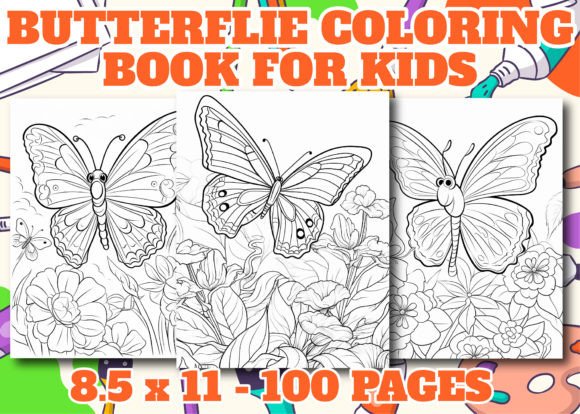
Butterflies Coloring Pages for Kids: A Scalable, Production-Ready Asset Suite for KDP and Print-on-Demand Creators
Butterflies Coloring Pages for Kids represent far more than simple line-art illustrations—they’re a carefully engineered creative asset system designed for real-world commercial deployment. Unlike generic clipart collections or low-resolution downloads found across free resource sites, this curated set bridges pedagogical value with production-grade technical specifications required by professional publishing platforms—especially Amazon Kindle Direct Publishing (KDP) and print-on-demand (POD) ecosystems.
Why Technical Fidelity Matters in Children’s Activity Content
Many creators underestimate how deeply file format, resolution, and dimensional consistency impact both usability and market performance. A coloring page intended for physical printing must meet strict mechanical thresholds: 300 DPI ensures crisp edges at full size; A4 (8.5” × 11”) dimensions align precisely with standard US letter and international paper trays; and vector-based AI files preserve infinite scalability without pixelation—critical when adapting designs for board books, classroom posters, or oversized activity pads.
Consider this practical example: A teacher preparing a butterfly-themed science unit may download a free PDF coloring sheet only to discover faint, anti-aliased lines that blur when photocopied. In contrast, the Butterflies Coloring Pages for Kids suite delivers clean, high-contrast outlines in every format—JPG for quick digital previews, PNG for transparent-background flexibility (e.g., overlaying on themed backgrounds), and AI for precise editing in Adobe Illustrator or Affinity Designer. That level of fidelity directly translates into reduced customer complaints, fewer returns on POD orders, and higher average ratings on Amazon listings.
Structural Versatility Across Use Cases
The collection’s strength lies not just in quantity—50 unique designs—but in intentional structural diversity. Each illustration balances developmental appropriateness with visual sophistication:
- Early Learners (Ages 3–5): Bold outlines, generous negative space, and simplified wing shapes support fine motor development and early pencil control.
- Elementary Students (Ages 6–9): Intricate patterns—mandalas within wings, botanical borders, geometric textures—encourage sustained focus and pattern recognition.
- Therapeutic & Inclusive Applications: Several pages feature symmetrical layouts ideal for bilateral coordination practice, while others integrate subtle nature education cues—like antennae labeled “sensory receptors” or wings annotated with “camouflage” and “warning coloration”—making them viable for special education or homeschool science integration.
This layered design philosophy means a single ZIP file serves multiple audiences simultaneously: a KDP publisher building a themed activity book series, a Montessori educator sourcing printable materials, or a small-batch POD brand launching an eco-conscious kids’ stationery line.
Workflow Integration for Commercial Publishers
For Amazon KDP sellers, time-to-market is often the decisive factor between opportunity and obsolescence. The Butterflies Coloring Pages for Kids eliminates common bottlenecks:
- No reformatting needed: All 50 JPG and PNG files arrive pre-cropped to exact 8.5” × 11” dimensions at 300 DPI—ready for direct import into KDP’s interior template without scaling artifacts or margin adjustments.
- AI files enable rapid customization: Need to add a title banner? Insert a copyright footer? Swap out a background element? Vector layers allow non-destructive edits—no raster-based guesswork or layer flattening required.
- Cover-ready assets included: The high-resolution cover image isn’t decorative filler—it’s a professionally composed layout with balanced typography zones and bleed-safe margins, enabling immediate use in KDP’s cover creator tool or as a base for custom branding.
Importantly, the absence of embedded watermarks, licensing restrictions, or usage tiers removes legal friction. Creators retain full commercial rights to modify, combine, and repurpose these assets across multiple titles—whether bundling them into a “Spring Nature Activities” compendium or licensing select pages to a school district’s learning management system.
Design Integrity Meets Developmental Research
Effective children’s coloring content doesn’t prioritize artistic novelty over cognitive function. These butterflies were developed with input from early childhood occupational therapists and elementary art educators. Key evidence-informed features include:
- Line weight consistency: Outlines range from 1.5pt to 3pt—not so thick as to overwhelm young eyes, not so thin as to disappear during mass printing.
- Strategic simplification: While retaining biological accuracy (e.g., distinguishing swallowtail vs. monarch venation), complex anatomical details are abstracted into rhythmic, repeatable motifs—supporting visual processing without inducing frustration.
- Intentional white space distribution: Each page avoids dense clustering; areas designated for coloring maintain minimum ¼-inch breathing room around edges and between elements—reducing smudging and supporting left- and right-handed users equally.
This attention to neurodevelopmental nuance differentiates the collection from algorithmically generated alternatives. It reflects iterative testing—not just with designers, but with actual children in classroom pilot sessions where engagement duration, eraser usage frequency, and verbal feedback (“This one’s easy!” / “I need help here”) were documented and used to refine line clarity and motif density.
Scalability Beyond Single-Title Publishing
While many creators acquire coloring assets for one-off projects, the Butterflies Coloring Pages for Kids suite supports long-term portfolio expansion. Because all files share consistent stylistic DNA—harmonized line quality, unified proportion systems, and cohesive thematic vocabulary—the assets interoperate seamlessly across product categories:
- Book series development: Launch a “Butterfly Life Cycle” workbook, then expand into “Pollinator Friends” (adding bees and hummingbirds) using the same foundational line style and layout logic.
- Cross-media adaptation: Convert PNG files into SVGs for interactive web coloring apps, or extract individual wing elements from AI files to create flashcards, sticker sheets, or laminated classroom manipulatives.
- Educational licensing: Bundle subsets of pages with lesson plans and NGSS-aligned discussion prompts for sale to curriculum developers—leveraging the technical readiness of source files to meet institutional procurement standards.
This interoperability reduces per-project overhead. Instead of sourcing, vetting, and standardizing new assets for each release, creators build upon a trusted, production-hardened foundation—freeing mental bandwidth for strategic differentiation like original storytelling, pedagogical scaffolding, or culturally responsive adaptations.
Operational Considerations for Responsible Use
Even high-quality assets require thoughtful implementation. Three practical considerations merit attention:
First, color theory alignment matters. While the pages are grayscale line art, their underlying structure influences how children perceive color relationships. Designs with adjacent large fields (e.g., wings beside body segments) invite exploration of complementary colors, whereas tightly interwoven patterns support analogous schemes. Savvy publishers annotate these possibilities in accompanying teacher guides or parent tips—adding perceived value beyond the artwork itself.
Second, accessibility extends beyond visual clarity. For learners with visual processing differences, pairing these pages with downloadable audio descriptions (“The top wing has three curved stripes pointing toward the tip”) or tactile overlays (raised-line versions via embossing services) transforms static pages into multimodal tools. The AI vector source makes such adaptations technically feasible without redesigning from scratch.
Third, contextual authenticity enhances engagement. Rather than presenting butterflies as isolated decorative motifs, integrating subtle ecological context—like native plant silhouettes in borders or seasonal indicators (chrysalis in spring, nectar sources in summer)—supports deeper learning. The collection’s design language accommodates such enhancements without compromising its core function as a coloring resource.
In essence, Butterflies Coloring Pages for Kids functions less as a static product and more as a flexible, extensible platform—one where technical precision, developmental insight, and commercial pragmatism converge to serve creators who value substance alongside scalability.