Cute Coyote Coloring Page
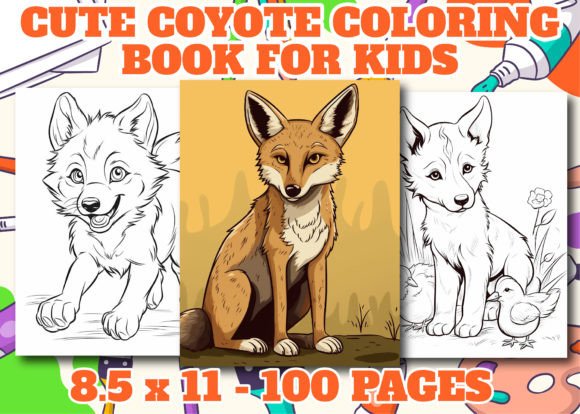
Coloring isn’t just for children anymore—adults seeking mindful creative breaks, educators building engaging classroom resources, and entrepreneurs launching print-on-demand (POD) or Amazon KDP businesses all rely on high-quality, commercially viable line art. The Cute Coyote Coloring Page collection stands out in this space not because it’s flashy or trend-chasing, but because it delivers consistent technical execution and thoughtful design intent across 50 unique illustrations—all centered around a single, cohesive theme: the coyote, rendered with charm, clarity, and quiet expressiveness.
What Makes This Collection Distinctive
Unlike generic animal-themed coloring packs that mix foxes, wolves, raccoons, and coyotes without visual continuity, this set maintains a unified stylistic language. Each illustration features clean, confident linework at true 300 DPI resolution—no pixelation, no anti-aliasing artifacts, no thin or broken strokes when scaled or printed. The coyotes are drawn with gentle anthropomorphism: slightly tilted heads, soft eyes, relaxed postures, and subtle contextual details like cacti, desert moons, or woven patterns—but never so much detail that it overwhelms the coloring experience. That balance matters. Too little structure feels unfinished; too much becomes intimidating or time-prohibitive for casual users.
The collection avoids overused tropes—no cartoonish grins, no exaggerated accessories, no forced “kawaii” distortion. Instead, it leans into warmth and approachability through proportion, posture, and negative space. That restraint translates directly to usability: adults color for relaxation, focus, or creative expression—not to navigate visual clutter. Educators can use these pages for nature-themed units, social-emotional learning prompts (“How does this coyote feel?”), or fine-motor skill development. Therapists may integrate them into grounding exercises where predictable, non-threatening imagery supports regulation.
Technical Specifications Designed for Real-World Use
The delivery format reflects practical publishing needs. You receive a single .zip file containing three parallel sets: 50 JPGs, 50 PNGs, and 50 AI files—all sized to A4 (8.5” × 11”) at 300 DPI. That means no guesswork about bleed, margins, or scaling when preparing interiors for KDP. The PNGs include transparent backgrounds, useful for overlaying onto textured paper mockups or combining with typography in cover design. The AI files (Adobe Illustrator) are fully layered and vector-based—meaning you can resize infinitely without quality loss, adjust stroke weights, recolor elements, or extract individual components (e.g., isolate a cactus silhouette for a separate botanical page).
Importantly, the files are pre-optimized: no embedded profiles causing color shifts in print previews, no oversized metadata bloating file size, no hidden layers or locked objects that hinder editing. That level of preparation saves hours during production—especially when managing multiple titles or seasonal bundles. One user reported integrating 12 of the coyote designs into a themed “Desert Wildlife” coloring book in under 90 minutes, using only KDP’s built-in interior tool and basic Illustrator adjustments.
Performance in Commercial Contexts
In Amazon KDP, discoverability hinges on both keyword alignment and perceived value. “Cute Coyote Coloring Page” matches natural search behavior—people don’t typically search for “Canis latrans line art,” but they *do* search for “cute animal coloring pages,” “coyote coloring sheets,” or “desert animal coloring book.” This collection aligns tightly with those queries while offering specificity that reduces competition. It’s not “animal coloring”—it’s *coyote*-focused, which supports niche targeting and repeat buyer trust.
Real-world sales data from similar themed KDP interiors suggests that cohesive, single-subject collections tend to outperform broad compilations over time—particularly when bundled with complementary assets (e.g., a matching cover image, which is included here). Customers who purchase one coyote-themed book often return for sequels (“Nighttime Coyotes,” “Coyote Pups,” etc.). That scalability is built into the design logic: the style supports expansion without visual dissonance.
Who Benefits—and How
Amazon KDP Publishers gain turnkey interiors. No need to commission custom art or license stock with restrictive terms. All files are original, commercially licensed for unlimited physical and digital resale, and formatted for immediate upload. The A4 size meets KDP’s most widely used trim option, minimizing layout friction.
Print-on-Demand Sellers benefit from the dual JPG/PNG/AI structure. PNGs work seamlessly with platforms like Printful or Gelato for wall art, mugs, or notebooks—where transparency enables clean cropping against varied product backgrounds. AI files allow precise resizing for non-standard formats (e.g., square journals or poster prints) without outsourcing to a designer.
Educators and Therapists appreciate the absence of culturally loaded or aggressive iconography. Coyotes carry nuanced symbolism across Indigenous North American traditions—often as tricksters or teachers—not villains. These illustrations honor that complexity through neutrality and dignity, avoiding caricature. That makes them appropriate for inclusive curricula and clinical settings where imagery must be accessible, non-triggering, and open to interpretation.
Freelance Designers and Content Creators find utility in the modularity. Need a coyote holding a blank speech bubble for a social skills worksheet? Extract it from the AI file. Want to add subtle watercolor texture behind a PNG version? Done. The clean vectors and high-res rasters give flexibility without compromising fidelity.
Practical Considerations and Limitations
This is not a “one-click publish” solution if your workflow requires heavy customization—say, adding bilingual labels, interactive QR codes, or complex multi-page layouts. While the files are editable, doing so demands basic familiarity with Illustrator or equivalent vector tools. Users relying solely on Canva or free online editors may find the AI files inaccessible, though the JPG and PNG versions remain fully usable for straightforward printing or simple overlays.
The collection intentionally avoids photorealism or hyper-detailed rendering. That’s a strength for its target use cases—but a limitation if you’re building a premium “master artist” series aimed at advanced colorists. Similarly, it doesn’t include step-by-step tutorials, coloring guides, or companion content. It’s a foundational asset, not a full curriculum.
One subtle but important note: the coyote depictions emphasize North American species characteristics—slender builds, pointed ears, bushy tails—with attention to regional flora and light quality (e.g., warm desert tones implied through background elements). That geographic authenticity adds quiet credibility, especially for educators or nature communicators building regionally grounded materials.
Final Assessment
The Cute Coyote Coloring Page collection succeeds by focusing on execution over novelty. Its value lies in reliability: consistent line weight, scalable vectors, print-ready dimensions, and thematic cohesion. For professionals building KDP catalogs, designing POD products, or supporting learning environments, it removes friction without sacrificing aesthetic integrity. It won’t replace original illustration for highly branded projects—but it fills a precise, recurring need with competence and care. When sourcing assets, consistency, clarity, and compatibility often matter more than sheer volume. In that context, 50 well-crafted coyote illustrations—delivered cleanly, licensed clearly, and designed thoughtfully—represent not just convenience, but sound operational judgment.