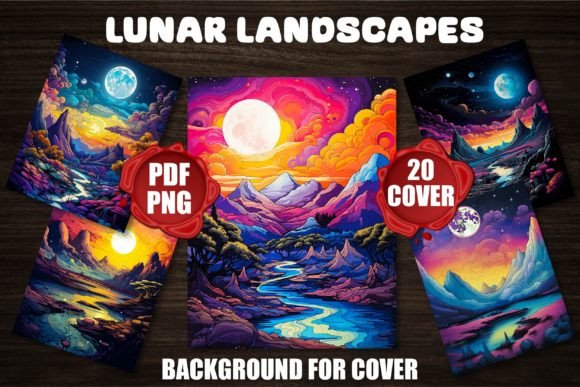
Lunar Landscapes Backgrounds for Cover: Where Cosmic Aesthetics Meet Creative Demand
Today’s creative professionals—whether indie authors launching on Amazon KDP, graphic designers building premium digital product suites, or wellness-focused entrepreneurs developing mindfulness resources—are navigating a marketplace that rewards both visual distinction and emotional resonance. In this context, Lunar Landscapes Backgrounds for Cover isn’t just another design asset bundle—it’s a timely response to converging trends in publishing, digital wellness, AI-augmented creativity, and consumer expectations for authenticity and atmosphere.
A New Standard for Cover Imagery in a Saturated Market
Book covers—especially on platforms like Amazon Kindle Direct Publishing—are the first and often only point of engagement with potential readers. With over 40,000 new titles published daily on KDP alone, standing out requires more than polished typography or generic stock imagery. Readers increasingly respond to covers that evoke mood, narrative depth, and subtle world-building—even before opening the first page. That’s where Lunar Landscapes Backgrounds for Cover delivers strategic value: each of its 20 high-resolution PNG files presents a meticulously composed lunar vista—not as sterile sci-fi cliché, but as evocative, atmospheric terrain. Cratered plains bathed in soft nebula light. Dust-swept horizons under binary suns. Silhouetted ridges against deep-space gradients. These aren’t backgrounds; they’re tonal anchors.
Unlike algorithmically crowded “space background” libraries saturated with lens flares and overused starfield overlays, this collection prioritizes compositional integrity and print-ready fidelity. At 300 DPI, every file supports professional-grade output—whether for matte-finish paperback covers, high-contrast coloring book exteriors, or layered digital mockups. For creators managing multiple KDP launches per quarter, having a cohesive, production-ready set of lunar-themed visuals eliminates hours of custom illustration or licensing negotiation—without sacrificing originality.
Bridging the Wellness Economy and Visual Storytelling
The rise of adult coloring books—and their documented role in stress reduction, mindful focus, and therapeutic expression—is no longer niche. According to recent market analyses, the global adult coloring book industry surpassed $1.2 billion in 2023, with compound annual growth projected through 2028. But what’s shifting is how consumers engage with these tools. Buyers no longer seek only intricate florals or mandalas—they’re drawn to themes that reflect personal identity, curiosity, and quiet wonder. Lunar landscapes fit precisely here: they’re inherently calming (low-contrast palettes, expansive negative space), symbolically rich (transformation, cycles, solitude), and universally accessible—no cultural translation required.
Consider a creator launching Stellar Stillness: A Lunar Meditation Coloring Journal. Using one of the included Lunar Landscapes Backgrounds for Cover as the front exterior immediately signals intentionality—this isn’t just another coloring book; it’s an invitation to contemplation framed by cosmic scale. Inside, the same aesthetic logic extends: the cover’s crater texture informs interior line art density; its twilight gradient guides color palette suggestions. This kind of visual continuity—enabled by a unified, high-fidelity background set—builds brand trust and reinforces perceived value, especially among repeat buyers in the self-care and creative wellness space.
AI-Generated Design, Human-Curated Intent
Yes, Lunar Landscapes Backgrounds for Cover are AI-generated—but not in the sense of generic prompt-to-output churn. These images reflect deliberate curation: controlled lighting models, intentional geological plausibility (crater distribution, regolith texture variation), and consistent celestial physics (accurate shadow angles, plausible atmospheric scattering). The result avoids the uncanny valley common in unrefined AI assets—no floating boulders, impossible perspective shifts, or chromatic noise. Instead, each image operates as a functional design layer: neutral enough for text overlay, detailed enough to hold attention at thumbnail size, and versatile enough to serve dual purposes—cover backdrop and printable coloring background.
This reflects a broader evolution in creative workflows. Professionals aren’t asking whether to use AI—they’re asking how to integrate it without diluting craft. Tools like this bundle represent a maturing phase: AI as collaborator, not replacement. A freelance designer can drop a lunar background into a KDP cover template in under two minutes, then spend focused time refining typography hierarchy and emotional tone—rather than rebuilding terrain from scratch. For solopreneurs managing end-to-end production (concept → design → upload → marketing), that efficiency compounds across projects, enabling faster iteration and more responsive audience testing.
From Niche to Necessary: Why Lunar Aesthetics Are Resonating Now
Lunar imagery has long carried symbolic weight—from Cold War-era ambition to contemporary climate consciousness. Today, it resonates differently: as metaphor for stillness amid chaos, for perspective in overwhelm, for beauty in austerity. Social media analytics show sustained growth in searches like “calming space art,” “minimalist moon design,” and “lunar meditation printable”—all reflecting a quiet pivot toward celestial minimalism over maximalist fantasy.
That shift aligns with tangible behavioral changes. Remote work and digital fatigue have heightened demand for visual environments that reduce cognitive load while stimulating imagination. Lunar landscapes deliver exactly that: low-saturation palettes ease eye strain; vast, uncluttered compositions support mental breathing room; and the inherent mystery of the moon invites projection—readers imagine their own stories onto those silent craters and distant horizons. For marketers building email banners, social ads, or course landing pages, leveraging this aesthetic isn’t decorative—it’s psychological alignment.
Practical Integration Across Use Cases
- KDP Authors: Pair a desolate lunar plain background with serif typography for literary sci-fi—or overlay soft watercolor textures for poetic memoirs. The 20 variants ensure thematic consistency across series without repetition.
- Coloring Book Creators: Use the same background as both front cover and interior title page, then extract key landforms as standalone line art for coloring pages—creating seamless visual continuity from shelf to coloring session.
- Digital Product Designers: Integrate lunar gradients into Notion templates, printable planners, or guided journal PDFs. The 300 DPI resolution ensures crisp rendering even when zoomed on tablet screens.
- Print-on-Demand Entrepreneurs: Scale elements from the backgrounds into greeting cards, art prints, or notebook covers—leveraging the same cohesive universe across physical SKUs.
Future-Proofing Creativity Through Intentional Assets
As platform algorithms grow more sophisticated—and consumer attention spans more fragmented—the value of pre-vetted, context-aware visual assets increases exponentially. Lunar Landscapes Backgrounds for Cover anticipates this by embedding versatility into its core structure: each file works equally well as a full-bleed cover, a subtle watermark layer, a textured overlay for typography, or a standalone printable. There’s no forced “theme lock-in”—a single crater field can anchor a thriller, a mindfulness guide, or a children’s astronomy primer, depending on supporting design choices.
More importantly, it reflects a growing professional consensus: that efficiency and artistry aren’t opposites. They’re interdependent. When creators spend less time sourcing or generating base layers, they invest more in voice, structure, and human-centered refinement—the elements no algorithm can replicate. In an era where “more content” is table stakes, Lunar Landscapes Backgrounds for Cover helps professionals deliver better content—grounded in atmosphere, built for impact, and designed for the way people actually see, feel, and choose in 2024 and beyond.