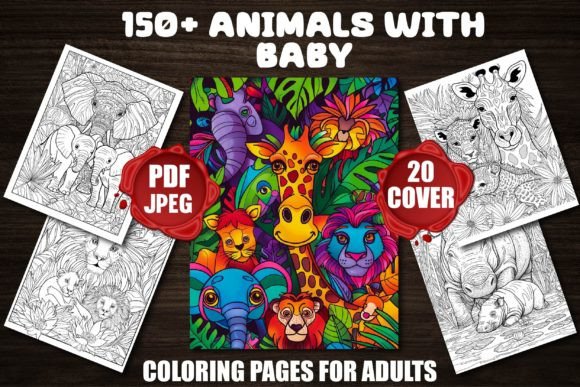
Animals with Baby Coloring Pages: A Strategic Creative Asset for Modern Creators and Wellness-Focused Brands
In an era defined by digital saturation, cognitive overload, and rising demand for intentional self-care, Animals with Baby Coloring Pages has emerged not merely as a niche printable product—but as a purpose-built creative tool aligned with evolving consumer behaviors, therapeutic design principles, and scalable digital publishing workflows. Designed specifically for adults, this collection transcends traditional coloring book expectations by merging emotional resonance, technical precision, and commercial versatility—making it especially relevant for professionals in publishing, mental wellness, education, and lifestyle branding.
A Thoughtfully Engineered Resource—Not Just Another Coloring Book
At its core, Animals with Baby Coloring Pages is a curated interior download comprising over 150 original black-and-white illustrations—each depicting tender interspecies bonds: a mother fox cradling her kits, an elephant calf nestled beneath its parent’s trunk, a barn owl guarding downy chicks in a hollow branch. These aren’t generic animal motifs; they’re narrative-driven compositions grounded in biological authenticity and gentle anthropomorphism—designed to evoke warmth, safety, and quiet awe.
What distinguishes this collection from mass-produced alternatives is its deliberate technical architecture. Every page is rendered at 300 DPI resolution, optimized for crisp line fidelity on standard A4 (8.5×11 inch) paper—a non-negotiable requirement for professional print-on-demand (POD) workflows, especially within Amazon Kindle Direct Publishing (KDP). Unlike low-resolution clipart compilations, these illustrations retain structural integrity even when scaled or adjusted for bleed margins, ensuring consistent output across printers, binding methods, and regional paper standards.
Meeting the Convergence of Mindfulness, Market Demand, and Digital Workflow Efficiency
The rise of Animals with Baby Coloring Pages reflects broader cultural and economic shifts. According to recent data from the Global Wellness Institute, the mindfulness market exceeded $1.5 trillion in 2023—with art-based interventions like coloring meditation gaining measurable traction among adults aged 28–54. This demographic isn’t seeking escapism alone; they’re investing in structured creative rituals that support focus, emotional regulation, and screen-free restoration.
Simultaneously, creators and entrepreneurs are redefining what “scalable content” means. Rather than chasing virality, forward-looking professionals prioritize modular, production-ready assets—digital products that integrate seamlessly into existing pipelines. The inclusion of 20 high-resolution PNG cover files (also at 300 DPI) exemplifies this shift. These aren’t decorative extras—they’re functional components enabling rapid A/B testing of cover variants, localization for international KDP storefronts, or adaptation for complementary offerings (e.g., matching journal covers, social media banners, or printable wall art bundles).
Why Design Precision Matters Beyond Aesthetics
Consider the practical implications: An illustrator launching their first KDP coloring book must navigate strict file specifications—including minimum line weight (0.5 pt), no grayscale gradients, and CMYK-safe contrast. Animals with Baby Coloring Pages was built with these constraints in mind. Its clean vector-derived linework avoids unintentional pixelation, while balanced negative space ensures optimal ink coverage on economical paper stocks—a critical factor for maintaining profit margins in competitive POD categories.
This attention to production detail mirrors trends across adjacent sectors. In educational publishing, for example, accessibility-first design now mandates sufficient contrast ratios and uncluttered layouts for neurodiverse learners. Similarly, therapeutic practitioners increasingly select coloring resources based on visual predictability—avoiding chaotic patterns that may trigger sensory overwhelm. The gentle rhythm of repeating organic shapes (feathers, fur textures, leafy backdrops) in this collection supports sustained engagement without cognitive fatigue—making it suitable not only for leisure but also for clinical and classroom integration.
Strategic Positioning in a Crowded Creative Marketplace
Within Amazon’s KDP ecosystem, “coloring book for adults” remains one of the most saturated yet resilient categories—generating over 27,000 new titles annually. Yet top-performing titles share a common trait: strong thematic cohesion backed by audience insight. Generic “animals” collections often underperform because they lack emotional anchoring. In contrast, Animals with Baby Coloring Pages taps into universally resonant psychological archetypes—the caregiver bond, intergenerational continuity, vulnerability and protection. This elevates perceived value beyond technique alone.
From a marketing perspective, this thematic clarity enables precise audience targeting. Social campaigns can speak directly to parents seeking shared activities, therapists recommending grounding tools, or gift buyers searching for meaningful presents for new mothers or retirees. Hashtag-aligned content—like #MindfulParenting or #TherapeuticArt—gains traction not through algorithmic luck, but because the product inherently supports those conversations.
Real-World Application: How Professionals Are Leveraging the Collection
- Freelance designers use the interior pages as base layers for custom-branded activity kits—adding client logos, guided reflection prompts, or QR-linked audio meditations—without redrawing line art.
- Wellness coaches bundle select pages into monthly “Creative Reset” subscriptions, pairing each illustration with a short mindfulness script focused on nurturing energy or boundary-setting.
- Educators adapt simplified versions for mixed-age classrooms, using the baby-animal motif to teach empathy, life cycles, or habitat conservation—demonstrating how high-fidelity source files enable responsible derivative use.
- KDP publishers run lean validation tests: uploading 10-page samplers with distinct cover treatments to gauge CTR and conversion before committing to full interior formatting—reducing time-to-market from weeks to days.
Future-Ready by Design
As generative AI reshapes creative tooling, human-crafted, ethically sourced, and contextually intelligent assets gain renewed importance. Animals with Baby Coloring Pages doesn’t compete with AI—it complements it. Its hand-drawn authenticity provides the “ground truth” data that informs better prompt engineering; its consistent style guide serves as a training anchor for custom fine-tuned models; and its commercial licensing clarity eliminates legal ambiguity common with scraped datasets.
Moreover, the collection anticipates emerging distribution channels. With rising interest in AR-enhanced coloring experiences (e.g., apps that animate completed pages), the clean, isolated linework ensures reliable edge detection and color-segment recognition—laying groundwork for future interactive extensions without requiring rework.
Conclusion: More Than Lines on Paper
Animals with Baby Coloring Pages represents a quiet evolution in digital creative infrastructure—one where emotional intelligence, production rigor, and entrepreneurial pragmatism converge. It meets today’s adult consumers where they are: seeking restorative practices that feel personal, not prescriptive; and it equips creators with assets engineered for real-world constraints—not theoretical ideals. In a landscape where attention is scarce and trust is earned through consistency, this collection delivers both aesthetic sincerity and operational reliability. That duality—between heart and utility—is precisely what makes it not just timely, but enduring.
Whether you’re building your first KDP coloring book, designing a wellness curriculum, or developing a branded self-care toolkit, Animals with Baby Coloring Pages offers more than inspiration. It offers a foundation—thoughtfully drawn, technically sound, and deeply human.