KDP Student Planner Canva: A Practical Interior Template for Academic Organization
For students, educators, and academic professionals preparing print-on-demand planners through Amazon Kindle Direct Publishing (KDP), the interior design phase is often the most time-consuming and technically sensitive step. That’s where KDP Student Planner Canva stands out—not as a standalone app or subscription service, but as a purpose-built, pre-tested interior template package designed specifically for KDP’s strict formatting requirements. Unlike generic Canva templates or DIY PDF builders, this resource delivers a complete, bleed-ready interior file optimized for academic planning across semesters, courses, and study habits.
What Makes KDP Student Planner Canva Distinct?
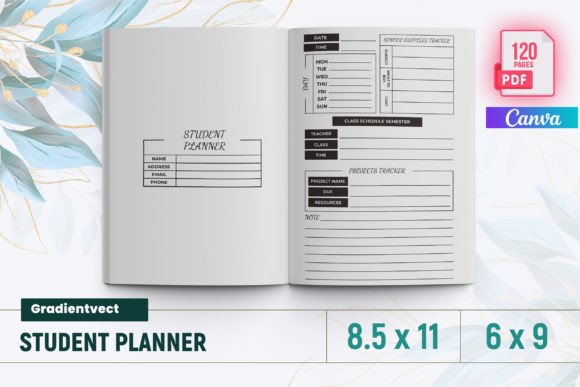
The core value of KDP Student Planner Canva lies in its specificity and readiness. It includes a single, production-ready PDF file—120 pages total—formatted to KDP’s 8.5 × 11 inch (6–9 trim size) specifications with full bleed. Every page has been validated on KDP’s previewer and live upload system, reducing the risk of rejection due to margin errors, resolution issues, or bleed misalignment. This eliminates the trial-and-error common when adapting free templates or exporting from general-purpose tools.
Beyond technical compliance, the content architecture reflects real academic workflows: not just blank calendars or generic to-do lists, but structured sections like Exam Timetable, Subject Lesson Plan, Assignment Ledger, Study Habits Tracker, and Mind Mapping pages. These aren’t decorative placeholders—they’re functional layouts with consistent spacing, typography hierarchy, and logical progression. The inclusion of PNG and JPG source files also allows for selective customization without compromising KDP compatibility, should users wish to adjust colors, fonts, or branding elements.
How It Compares With Other Planning Resources
Many planners begin with broad digital tools—Notion databases, Google Sheets, or even Excel-based trackers. These offer flexibility and real-time syncing, but they lack the tactile utility and focused structure of a printed planner. More importantly, they don’t translate directly into a KDP-compliant interior. Converting such files into print-ready PDFs often requires manual reformatting, image resampling, bleed setup, and font embedding—tasks that introduce error risk and consume hours.
Other Canva-based planner templates exist, but most are designed for personal use or social media sharing—not KDP publishing. They frequently omit bleed, use web-optimized JPEGs instead of high-resolution PNGs, or rely on non-embedded fonts that render inconsistently during KDP processing. In contrast, KDP Student Planner Canva treats the interior as a publishable artifact first, not an afterthought.
Compared to fully custom design services (e.g., hiring a graphic designer via Fiverr or Upwork), KDP Student Planner Canva offers immediacy and cost efficiency. There’s no back-and-forth on revisions, no learning curve for design software, and no dependency on third-party timelines. Yet it doesn’t sacrifice adaptability: because the package includes layered PNG/JPG assets, users comfortable with basic image editing can modify headers, icons, or color schemes without rebuilding the entire layout.
Strengths and Real-World Fit
The primary strength of KDP Student Planner Canva is its balance between structure and practicality. Consider a graduate student managing thesis deadlines, teaching assistant responsibilities, and conference submissions. A planner that combines Weekly Tasks Tracker, Academic Accomplishments, Assigned Reading, and Seminar Notes in one cohesive flow supports that complexity better than fragmented apps or minimalist bullet journals.
Similarly, instructors designing course-specific planners benefit from sections like Class Schedule, Teacher Contact List, and Course Materials—pages that anticipate recurring administrative needs rather than assuming generic use cases. The Grade Tracker and Attendance Record pages, for instance, follow standard academic reporting conventions, avoiding ambiguous fields or unclear units.
This level of contextual awareness makes KDP Student Planner Canva especially useful for those who value consistency across semesters—whether maintaining long-term goals with the Bucket List and Semester Goals pages, or tracking progress with the Project Planner and Homework Tracker. The repeated use of dual-column layouts, subtle grid lines, and ample white space also supports readability during extended study sessions—something many digital alternatives overlook in favor of visual density.
Limitations and When to Look Elsewhere
While comprehensive, KDP Student Planner Canva isn’t infinitely scalable. It assumes a fixed 120-page count and standard 8.5 × 11 format. Users needing smaller trim sizes (e.g., 6 × 9 for portability), alternate binding styles (spiral vs. perfect), or highly specialized subject matter—like lab notebooks for chemistry majors or clinical logs for nursing students—may find the template too generalized. Likewise, those requiring interactive elements (hyperlinked tables of contents, embedded forms, or QR code integration) won’t find them here; this is a static, print-first interior.
If your goal is rapid iteration—testing multiple cover designs, experimenting with different page counts per section, or A/B testing layouts for market response—then building from scratch in Canva or Adobe InDesign may offer more granular control. And if you prioritize accessibility features (screen-reader–friendly tagging, alt-text for diagrams, or dyslexia-friendly fonts), this template does not include those enhancements out of the box.
Practical Decision Factors
Choosing KDP Student Planner Canva comes down to three interrelated questions:
- Do you need a production-ready interior now? If yes—and you’re confident in your cover design and marketing strategy—this saves days of troubleshooting KDP’s validation system.
- Does your target audience expect academic rigor over aesthetic novelty? Students and faculty respond well to functional clarity: clear headings, predictable section order, and consistent data entry points. This template prioritizes that over trend-driven design.
- Are you balancing speed, reliability, and moderate customization? If you want to tweak colors or add a university logo but don’t want to rebuild every page, the included PNG/JPG assets make that feasible without deep design expertise.
Conversely, if your project demands heavy localization (e.g., translating all prompts into Spanish or Arabic), requires dynamic content generation (auto-populated dates, conditional logic), or targets niche pedagogical models (Montessori, Waldorf, or competency-based frameworks), then starting from a blank canvas—or collaborating with a specialist—may be more appropriate.
Final Considerations for Informed Use
Using KDP Student Planner Canva effectively means understanding both its capabilities and constraints. It excels at accelerating time-to-market for academically grounded planners, particularly for creators who’ve already navigated KDP’s cover upload process and understand basic metadata best practices. Its value isn’t in replacing critical thinking about user needs—but in removing avoidable friction in execution.
Realistic expectations matter: this isn’t a “set and forget” solution. You’ll still need to write compelling sales copy, choose an effective cover, define your ideal reader persona, and consider how your planner fits within broader categories like Daily Planner, Weekly Planner, or Exam Timetable—all of which appear in the interior. But with the structural foundation already validated and organized, you can invest energy where it matters most: refining utility, clarifying instructions, and aligning each section with actual student behaviors—not theoretical ones.
In short, KDP Student Planner Canva serves best as a thoughtful starting point—not a final destination. It meets a specific need with precision: turning academic planning logic into a KDP-compliant, print-ready interior, without demanding design fluency or sacrificing functional depth.