Recipe Book Template Canva KDP: A Practical Tool for Modern Food Creators and Self-Publishers
Creating a professional, print-ready recipe book no longer requires design expertise, months of formatting, or expensive software. Today’s food bloggers, home chefs, meal-prep coaches, and culinary educators are turning to the Recipe Book Template Canva KDP—a purpose-built, editable interior template designed specifically for Amazon Kindle Direct Publishing (KDP). This isn’t just another Canva layout; it’s a tested, bleed-ready, 120-page interior that meets KDP’s strict specifications out of the box.
Why This Template Fits Real-World Publishing Needs
Amazon KDP remains one of the most accessible platforms for independent authors—but its technical requirements can trip up even experienced creators. Margins, bleed settings, resolution standards, and file format compatibility matter. A single error in image DPI or page size can trigger rejection during upload, delaying launch by days—or worse, undermining reader trust with misaligned text or cropped photos.
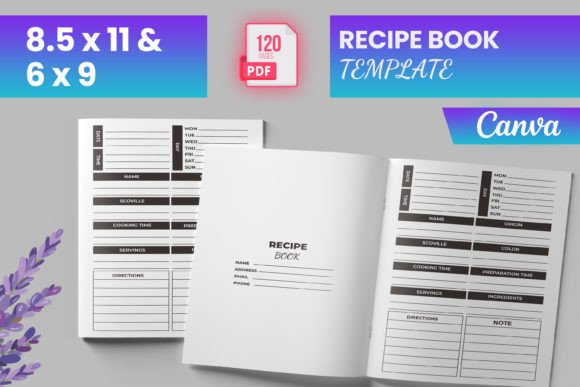
The Recipe Book Template Canva KDP eliminates guesswork. It includes a ready-to-upload PDF file optimized for KDP’s 6" × 9", 8.5" × 11", and other standard trim sizes. Every page is built with 0.125" bleed, ensuring that background colors and full-bleed food photography extend cleanly to the edge of the printed page. The interior has been validated on KDP’s previewer and live upload system—so what you see in Canva is what readers receive in print.
What You Actually Get—and Why Each Element Matters
This isn’t a minimal starter file. It’s a fully structured interior built around usability, flexibility, and publishing compliance:
- Ready-to-upload PDF file: No last-minute conversions or compression risks. Generated directly from Canva with CMYK color profile and embedded fonts.
- Multiple trim sizes supported: Works seamlessly at 6" × 9", 7" × 10", 8.5" × 11", and more—ideal whether you’re targeting compact kitchen counters or large-format coffee-table appeal.
- 120 total pages: Enough space for an introduction, table of contents, 80–100 recipes (with consistent spacing), indexes, notes sections, and resource pages—without needing to add or delete pages mid-process.
- Dedicated intro page: Designed to establish voice and credibility—critical for building connection before the first recipe.
- KDP-tested files: Includes both high-res PNG and JPG assets, all exported at 300 DPI and sized correctly for interior use—not web previews or social thumbnails.
- Bleed-ready interior: Backgrounds, photo borders, and decorative elements extend safely beyond the trim line, preventing unintended white edges after cutting.
That attention to detail reflects how self-publishing expectations have shifted. Readers now judge books not just by content but by production quality—even for niche cookbooks. A slightly off-center heading or inconsistent spacing signals carelessness. With this template, consistency isn’t optional; it’s baked into the grid, typography hierarchy, and spacing logic.
How Creative Workflows Have Changed—and What That Means for Recipe Authors
Five years ago, many food creators outsourced formatting or used generic Word templates. Today, speed, control, and brand alignment are non-negotiable. A wellness coach launching a keto meal plan needs to update ingredient swaps across 30 recipes overnight—not wait for a designer’s turnaround. A bakery owner documenting family recipes wants to insert seasonal photos without relearning InDesign.
Canva’s intuitive interface makes those updates possible. Because this Recipe Book Template Canva KDP is fully editable in Canva (free or Pro), users can swap fonts, adjust color palettes, replace placeholder images with their own food photography, and modify section headers—all while preserving KDP compliance. There’s no need to understand “preflight checks” or “imposition.” Just edit, export, upload.
That shift mirrors broader changes in digital content creation: tools are converging, workflows are flattening, and domain-specific knowledge (like print publishing) is being abstracted into guided interfaces. What once required three specialists—writer, photographer, designer—can now be handled thoughtfully by one person, using the right foundation.
Real Use Cases Beyond the Obvious
While obvious users include cookbook authors and food bloggers, the utility extends further:
- Educators creating classroom nutrition guides or student-led cooking projects—customizable layouts let teens add illustrations or reflection prompts without design barriers.
- Meal-prep subscription services bundling digital + print offerings: the same Canva file becomes both a downloadable PDF for members and a KDP paperback for retail.
- Nonprofits and community kitchens documenting culturally significant dishes—consistent formatting honors tradition while making content accessible across literacy levels.
- Freelance food stylists and photographers offering branded “recipe kits” as value-adds to clients—using the template as a polished delivery format.
None of these require mastery of prepress. They do require reliability—and that’s where the KDP-tested validation matters. It’s not about theoretical compatibility. It’s about knowing your 8.5" × 11" version won’t get flagged for margin errors, or that your JPG-based step photos retain clarity when compressed by KDP’s backend systems.
Design Integrity Without Compromise
Some editable templates sacrifice structure for flexibility—resulting in inconsistent spacing, awkward line breaks, or broken grids when text is updated. This Recipe Book Template Canva KDP avoids that pitfall through intentional design constraints: fixed header styles, responsive text boxes with auto-height, and locked layer groups for recurring elements like ingredient lists or prep-time badges.
Typography follows readability best practices: clear hierarchy between titles, subheadings, and body text; sufficient line height for scanned reading; and font pairings that support both serif elegance (for intros) and clean sans-serif utility (for instructions). Even small choices—like left-aligned (not justified) body text and generous margins around recipe cards—reduce cognitive load for cooks flipping pages with flour-dusted fingers.
Practical Next Steps for Users
If you’re evaluating whether this template fits your project, ask yourself:
- Do I need to publish quickly—without back-and-forth with designers or learning new software?
- Will my content benefit from consistent visual framing (e.g., uniform photo treatment, standardized yield/prep time placement)?
- Am I targeting readers who expect polished physical books—not just digital downloads?
- Do I want flexibility to iterate later (e.g., adding a holiday supplement or updating measurements for metric audiences)?
If you answered yes to two or more, the value proposition becomes clear. You’re not buying a static document—you’re acquiring a repeatable, scalable system. One that supports version control (save iterations in Canva), collaborative editing (share with co-authors or editors), and future expansions (duplicate pages, adjust color themes per series).
And because it’s delivered instantly as a downloadable package—including PDF, PNG, and JPG assets—you avoid delays common with custom design services. No waiting for revisions. No hidden fees for extra pages or size adjustments. Just open Canva, personalize, and publish.
A Grounded Take on the Future of Food Publishing
Trends like “digital detox cooking,” hyperlocal ingredient sourcing, and multi-generational kitchen knowledge-sharing aren’t just cultural shifts—they’re driving demand for tangible, well-made recipe books. But readers won’t tolerate poor production. They expect the same polish from indie authors as they do from established publishers.
The Recipe Book Template Canva KDP responds to that expectation—not with hype, but with precision. It doesn’t promise viral success or guaranteed bestseller status. It delivers something quieter but more essential: confidence. Confidence that your voice, your recipes, and your vision will land exactly as intended—on the shelf, in the kitchen, and in the hands of someone who’ll make your dish tonight.